When Food Manufacturers Outgrow QuickBooks: Signs It’s Time for an ERP
As food manufacturers grow, basic accounting software like QuickBooks often falls short, limiting operational efficiency, compliance, and scalability. This article highlights signs that indicate it’s time to transition to a robust Enterprise Resource Planning (ERP) system. Readers will learn about the complexities of food manufacturing, compliance and inventory needs, ERP features tailored for the industry, and the implementation process for a smooth transition.
Signs You Need ERP
Recognizing QuickBooks’ limitations is key for scaling food manufacturing operations. As complexity grows, QuickBooks may no longer suffice. Key signs include:
- Inventory Management Becomes Difficult: QuickBooks lacks real-time tracking and differentiation between raw materials, work in progress, and finished goods, unlike ERP systems designed for food manufacturers.
- Compliance Challenges: QuickBooks cannot adequately track food safety regulations. ERP systems include modules to manage FDA compliance, simplifying audits.
- Complex Food Production: QuickBooks struggles with dynamic production demands. ERP systems streamline production lines, labor costs, and raw material management.
- Advanced Financial Reporting Needed: QuickBooks offers basic reports, but ERP systems provide advanced analytics for manufacturing costs, sales, and profitability.
Identifying these signs is the first step to improving efficiency. Firefly Business Group specializes in ERP solutions tailored for small to medium food and beverage manufacturers, processors, distributors, co-packers, and e-commerce food companies.
Research underscores the importance of a well-managed ERP transition for optimizing production and inventory efficiency in food manufacturing.
ERP Transition for Production & Inventory Efficiency in Food Manufacturing
This case study examines production and inventory efficiency gains after implementing Acumatica Cloud ERP with SimplyFood Software at House Autry, a leading U.S. dry-mix and breader producer with facilities in North Carolina and Georgia. It evaluates the transition from a legacy ERP system using lean manufacturing principles and key operational KPIs, analyzes implementation challenges (such as complex workflows and error-prone processes), their operational impact, and provides strategic recommendations for food manufacturers seeking scalable, real-time visibility and compliance.
Improving Production Efficiency in Food Manufacturing for House Autry, Firefly Business Group, 2026
ERP Features Tailored for Food Manufacturing
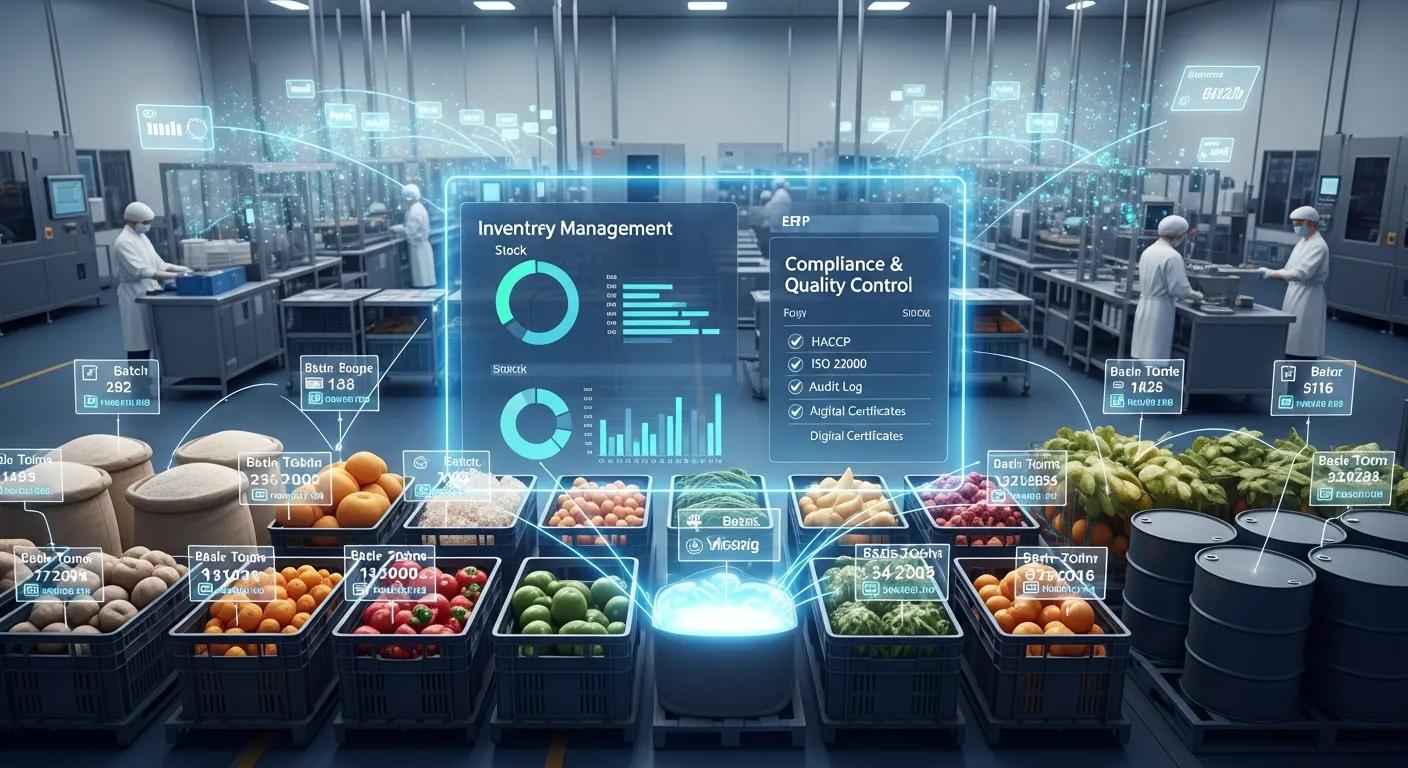
When your food business outgrows QuickBooks, seek an ERP built for the food and beverage industry’s unique needs. Modern ERP software offers industry-specific features to streamline operations, boost efficiency, and ensure compliance with evolving food safety regulations.
Inventory management is central. ERP software tracks raw materials, finished goods, and everything in between in real time, reducing waste, preventing stockouts, and keeping production smooth. Integrated warehouse tools support efficient storage, picking, and shipping.
Supply chain management features monitor suppliers, manage lead times, and optimize the supply chain, enabling quick responses to disruptions and strong supplier relationships.
Quality control and food safety modules help track compliance, manage audits, and document production steps, reducing risk and protecting brand reputation.
Recipe management standardizes formulations and production scheduling, ensuring product consistency and scalability.
Integrated financial systems simplify budgeting, cash flow, and accounting across entities, providing real-time data and analytics for informed decisions.
Customer relationship management (CRM) tools manage interactions, track sales, and improve service, enhancing customer satisfaction and loyalty.
ERP systems integrate seamlessly with supply chain and warehouse operations, ensuring accurate data flow and supporting continuous improvement.
These features demonstrate how ERP systems address food manufacturers’ unique challenges, enhancing operations and ensuring compliance.
From QuickBooks and Disconnected Tech Stacks to Centralized ERP
Many food manufacturers start with QuickBooks supplemented by various software for inventory, production, compliance, and customer management. This patchwork often lacks integration, creating data silos that cause delays, miscommunication, and errors.
Additionally, many systems are not fully cloud-based, limiting real-time access and collaboration. This fragmentation hinders comprehensive operational visibility and swift responses.
Centralized ERP systems integrate core functions into one platform, breaking down silos and enabling seamless communication. Real-time data access provides complete visibility into inventory, production, finances, and customer interactions.
This insight empowers quick, informed decisions, proactive adjustments, and opportunity capitalization. Unifying your tech stack with ERP enhances efficiency, reduces errors, and fosters transparency and agility for sustained growth.
Compliance and Traceability Benefits
ERP systems enhance compliance and traceability in food manufacturing, crucial for product quality and consumer trust. They streamline regulatory reporting and ensure documentation is accessible, supporting quality assurance.
Studies highlight ERP’s role in maintaining strict food safety and quality standards, especially in organic production.
E-commerce and Distribution Integration
Integrating ERP with e-commerce platforms is vital in today’s digital marketplace. It improves order management and inventory control, enabling quick responses to customer demands. Automation reduces errors and enhances customer satisfaction, boosting sales and loyalty.
Implementation Process and ROI

Implementing an ERP involves a structured process with significant ROI potential. Key steps include:
- Assessment of Needs: Evaluate current processes and identify ERP requirements.
- Selection of ERP Software: Choose a solution aligned with food manufacturing needs.
- Data Migration: Transfer data from QuickBooks accurately and completely.
- Training and Support: Provide staff training for smooth adoption.
- Continuous Improvement: Regularly assess and optimize ERP performance.
ERP implementation can substantially improve efficiency, compliance, and customer satisfaction, leading to higher profitability. Firefly Business Group offers tailored ERP solutions for food manufacturers to support this transition.