
FSMA 204 traceability
FSMA 204 got delayed. Your customers didn’t.
The FDA won’t enforce the Food Traceability Rule before July 20, 2028. Your retail customers and your SQF auditor aren’t waiting that long. Here’s what the rule asks, and two quick ways to see where you stand.
12 questions, about five minutes, no email. You get a Readiness Score, an urgency level and next steps.
Updated October 26, 2026. Sources: FDA and 21 CFR Part 1 Subpart S.

The 24-hour question
The 24‑hour question
A retail customer calls about one lot of an ingredient you received last month. Could you send every affected shipment, in a sortable spreadsheet, within 24 hours?
That’s the test FSMA 204 sets. It’s also the question your biggest customers and your auditor already ask.

The floor got better. The handoff is the hard part.
Lots of food companies have moved receiving and production off paper. The harder part sits a level up, when the floor system, the office ERP and a few spreadsheets each hold a piece of the same lot’s story. A trace that needs three systems and two people is a trace that’s slow on a Saturday.


Why FSMA 204 is real now

1
The FDA date moved. The FDA won’t enforce the Food Traceability Rule before July 20, 2028 (it was January 20, 2026). Congress set that in the 2026 continuing appropriations act. That’s the FDA’s date, not your customers’.
2
Retailers are asking now. Walmart asks food suppliers for advance ship notices with lot or batch data, and it said it expects suppliers to keep to the original timelines. In an August 11, 2026 letter, Kroger asked suppliers to name a FSMA 204 contact by September 9, 2026, and said it will require items to be traceable through its supply chain beyond what FSMA 204 requires.
3
Your SQF auditor is asking now. If you’re SQF certified, Edition 10 expects you to test your trace system and your recall program at least once a year.
4
Narrow recalls stay small. A recall you can’t narrow to specific lots tends to become a bigger one.
Working back from 2028 matters. System selection, implementation, a stretch of clean lot records and at least one mock recall all have to fit before that date.
Not sure how ready you are? Twelve questions, about five minutes, no email. Get Your Readiness Score.
What the FSMA 204 rule asks of manufacturers and distributors
The rule covers companies that manufacture, process, pack or hold foods on the FDA Food Traceability List, and foods that contain them as ingredients in the same form. Check the list for your products and ingredients. It names foods like soft and fresh cheeses (other than hard cheeses), shell eggs, nut butters, fresh herbs, fresh leafy greens, finfish and crustaceans.
At each critical tracking event you keep key data elements tied to a traceability lot code.
1
Receive
Record the traceability lot code, quantity and unit of measure, product description, who you got it from, where you received it and the date.
2
Transform
When you make or repack a product, link each covered input lot to the new finished lot code.
3
Ship
Keep and pass along the lot code, quantity, product, the customer, where it shipped from, the date and where the lot code was assigned.
4
Respond in 24 hours
Give records to the FDA within 24 hours of a request. In an outbreak or recall, that means an electronic sortable spreadsheet for most covered companies.
If you’re a distributor
If you receive and ship covered foods without changing them, your job is mostly the receiving and shipping records, and passing the lot code your supplier assigned along to your customer. You assign a new traceability lot code when you transform a food, like repacking or relabeling it. You also keep a written traceability plan either way.
Distributors, see how ready your receiving and shipping records are. Get Your Readiness Score.
Key data elements at a glance
| Receiving | Transformation | Shipping |
|---|---|---|
| Traceability lot code | Input lot codes used | Traceability lot code |
| Quantity and unit of measure | New traceability lot code | Quantity and unit of measure |
| Product description | Product description and quantity of the new lot | Product description |
| Immediate previous source | Where the new lot code was assigned | Immediate subsequent recipient |
| Where you received it | Date of transformation | Where you shipped it from |
| Date received | Reference document | Date shipped |
| Where the lot code was assigned | Where the lot code was assigned | |
| Reference document | Reference document (keep only) |
(Sources: 21 CFR 1.1340, 1.1345, 1.1350, 1.1455)
Want this as a checklist you can print and mark Yes, No or Partly? Get the Full Checklist.
Self-check
A five-question traceability self-check
Want a score and a plan? Get Your Readiness Score. Rather work from a list? Get the Full Checklist.
Three paths
Three paths growing food companies take
One way to get there: lot traceability in your ERP
Capture lot data once, when it happens, in the same system that runs receiving, production, inventory, sales and the books.

Not sure which fits? Get Your Readiness Score and the result points you to the right one.
Coming from QuickBooks or spreadsheets?
That’s where a lot of the 24-hour pain starts, because the lot lives in a spreadsheet and the shipment lives in the books. SimplyFood Production is built on Acumatica Distribution Edition as a lite food production option for exactly that move.
Still on QuickBooks? We can trace one of your lots side by side with how you do it today. See a Demo.
Proof point
Proof point: House Autry
House Autry, a growing dry mix producer, implemented Acumatica with SimplyFood. Their case study reports that quality now tracks lot consumption from the same Production Cost Review inquiry that accounting and purchasing use.
How close is your team to that? Get Your Readiness Score.
FAQ
FSMA 204 FAQ
Keep reading
Also worth a read
- Signs you’ve outgrown QuickBooks: The warning signs that spreadsheets and QuickBooks can’t keep up with lot tracking.
- essential ERP features for food production
- Get the Full Checklist: every record the rule asks for, emailed to you as a printable PDF. Print it, mark each line Yes, No or Partly, and see where your trace breaks.
Sources
- FDA, FSMA Final Rule on Requirements for Additional Traceability Records for Certain Foods (fda.gov)
- FDA Food Traceability List (fda.gov)
- FDA FSMA 204 FAQ (fda.gov)
- 21 CFR Part 1 Subpart S (ecfr.gov)
- Kroger supplier letter (August 11, 2026) (thekrogerco.com)
- Walmart food traceability requirements (walmart.com)
- SQFI Product Withdrawal and Recall guidance (sqfi.com)
- GS1 US FSMA 204 FAQ (gs1us.org)
Get the Full Checklist
Get the Full Checklist
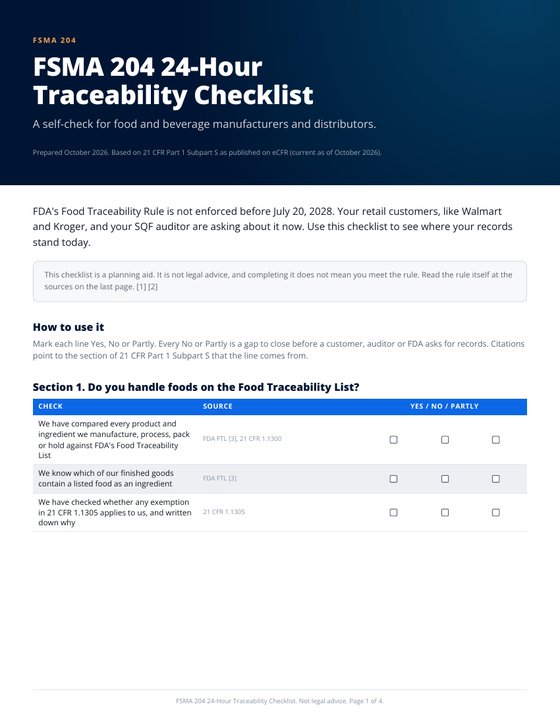
Every record the rule asks for at receiving, production and shipping, in one printable checklist sourced to the FDA rule.
What's inside
- Check your products and ingredients against the FDA Food Traceability List
- Your traceability plan and traceability lot codes
- Key data elements at receiving, transformation and shipping, each cited to 21 CFR Part 1 Subpart S
- The 24-hour test: can you produce the records within 24 hours of an FDA request?
Preview: form goes live after approval
How ready are you for the 24-hour test?
Take the 12-question assessment for a Readiness Score and next steps on screen, no email needed. Want every record the rule asks for in one place instead? The full checklist is just above.
Prefer to talk it through? See a Demo or call (877) 589-8677.